

- Verification Tier System, Requirements, and Transaction Thresholds
- Anti-Money Laundering (AML) Protocols and Risk Assessment Architecture
- Technical Execution Protocol: Submitting Documents for BC Game KYC Approval
- Cryptographic Data Protection, Encryption, and Privacy Compliance
- Data Retention, Access Controls, and KYC Resubmission
- Regional Compliance Standards and Frequently Asked Questions (FAQ)
The review may later expand to a KTP or passport, facial comparison, Proof of Address and Source of Funds evidence. OCR extracts document fields, liveness technology checks whether a real person is present, and AML screening evaluates transaction and location signals. Cases with conflicting data or elevated risk move to manual compliance review. Once verification is requested, completing KYC becomes a mandatory condition for protecting the platform’s financial pool and restoring access to the affected financial functions.
BC.Game is operated by Twocent Technology Limited, registered in Belize under number 000041939 at Sea Urchin Street, San Pedro, Ambergris Caye, Belize. It operates under Anjouan licence ALSI-202410011-FI1 and may retain Curaçao references in contractual materials. Verification does not override Indonesia’s restrictions on online gambling.
Indonesian users remain responsible for checking local law and providing authentic, current documents issued in their own names. Incorrect metadata, edited images or records belonging to another person can result in additional checks, payment restrictions or blocked account access.
Verification Tier System, Requirements, and Transaction Thresholds

The BC Game kyc framework applies three verification levels. Tier 1 indexes basic personal data. Tier 2 connects those details to official identification and a selfie. Tier 3 adds residential and financial evidence when an account reaches an enhanced risk trigger.
Basic Verification (Tier 1) and Initial Data Indexing
Tier 1 records the full legal name, date of birth, country and confirmed email address or telephone number. These fields become the reference point for later automated and manual comparisons.
Users should copy their details from official identification. Differences in spelling, name order or birth date can create an OCR mismatch even when the uploaded document is genuine.
Advanced Identity & Address Verification (Tier 2 & 3)
Tier 2 compares the account record with an Indonesian KTP, valid passport or another accepted ID, together with a current selfie. Tier 3 may request a bank statement, utility bill, tax certificate and evidence explaining the origin of the account’s funds.
Withdrawal thresholds are account-specific. The concrete limit is the value displayed in the authenticated dashboard for the relevant user, asset and payment route. A single universal amount in IDR should not be applied to every account.
Table 1: KYC Verification Tiers & Threshold Specifications
| Verification Level | Required Documentation | Trigger Threshold | Account Functionality Unlocked |
| Tier 1 (Basic) | Personal Metadata & Contact Validations | Standard Registration | Baseline Cryptographic Operations |
| Tier 2 (Intermediate) | Government ID (KTP/Passport) + Selfie | High-Volume Financial Threshold | Expanded Withdrawal Limits & FIAT Rail Access |
| Tier 3 (Advanced) | Proof of Address + Source of Funds (SOF) | Enhanced Risk Matrix Trigger | Unlimited Financial Operations & Custom Limits |
Passing one tier does not permanently remove further checks. New financial behaviour, payment methods or location signals may initiate another review.











Last used 6 minutes ago
Anti-Money Laundering (AML) Protocols and Risk Assessment Architecture

AML monitoring compares identity and payment information with account behaviour. It can screen PEP and sanctions records, detect duplicate profiles and identify activity that differs materially from the user’s established pattern. Automated screening can also examine on-chain wallet activity, transaction velocity and links between submitted addresses and previously flagged blockchain entities.
Compliance and security verification use these indicators:
- Government-Issued Photo ID: Valid Indonesian National Identity Card (KTP), Passport, or Driver’s License.
- Proof of Residential Location: Utility bills, bank statements, or official tax certificates not older than 90 days.
- Biometric Liveness Verification: Real-time facial scan and 3D depth mapping to prevent spoofing and AI impersonation.
- Source of Wealth Validation: Tax returns, employment contracts, or audited financial statements for high-tier accounts.
A document can be valid yet unsuitable for the account if its name, birth date or address conflicts with the registered profile. Such inconsistencies require clarification rather than automatic approval.
The risk engine examines these AML compliance parameters:
- consistency between identity, account and payment information;
- matches against PEP and international sanctions data;
- several profiles connected to one person or device;
- proxy use and rapid changes in country or IP address;
- transaction volume inconsistent with earlier activity;
- expired, incomplete or digitally altered evidence.
A detected signal begins an investigation. It is not, by itself, proof of fraud, money laundering or another offence.
Enhanced review may rely on these Source of Funds indicators:
- salary supported by an employment contract;
- revenue from an identifiable business;
- dividends or documented investment proceeds;
- proceeds from a verified asset sale;
- tax returns or official income declarations;
- audited personal or corporate statements.
An IDR bank statement should clearly show the account holder, issuing institution and transactions relevant to the declared source. Its fiat value does not replace the original cryptocurrency or network information.
Table 2: SLA & Processing Latency Metrics for Document Verification
| Verification Stage | Processing Mechanism | Target SLA Window | Maximum Resolution Time |
| Document OCR Screening | Automated AI Extraction | Real-time (< 30 seconds) | 5 Minutes |
| Manual Compliance Review | Senior AML Auditor Desk | 1–6 Hours | 24 Hours |
| Enhanced Due Diligence (EDD) | Legal Compliance Team | 12–24 Hours | 48 Hours |
The SLA applies to a complete and usable submission. Unreadable images, missing pages or a new request for financial evidence can extend the overall review.
Last used 6 minutes ago
Technical Execution Protocol: Submitting Documents for BC Game KYC Approval

The BC Game kyc portal accepts JPEG, PNG and PDF files. Images should be submitted in colour and at a resolution that keeps small text legible. The document must remain fully visible, including every corner, photograph and security feature. Glare, filters, cropped margins and digital editing can cause rejection.
The Document Submission and Identity Verification Sequence has four stages:
- Session Authentication and KYC Portal Access: Sign in to the BC.Game dashboard and open the encrypted Security/KYC node within user settings.
- Metadata and Document Upload: Enter matching personal information and upload high-resolution images of valid identification without cropped or altered content.
- Biometric Liveness Verification: Complete the camera-based 3D liveness scan so the system can compare the applicant with the identification photograph.
- Status Monitoring and Verification Output: Monitor document parsing in the security dashboard until approval or manual compliance feedback appears.
Identity records should be submitted only through the authenticated platform interface. Social-media messages, public forums and links supplied by unverified representatives are unsuitable channels for KYC files.
Last used 6 minutes ago
Cryptographic Data Protection, Encryption, and Privacy Compliance

KYC documents combine identity, location and financial information in one record. Protection must therefore cover transmission, storage, backups, access permissions and audit history.
The security architecture applies these standards:
- TLS 1.3 encryption during transmission to the verification system;
- AES-256 encryption for documentation stored at rest;
- isolated database nodes for sensitive identity records;
- zero-trust permissions for compliance access;
- audit logs for document access and status changes;
- restricted processing rights for approved verification infrastructure.
Encryption protects information inside the controlled environment. Users must still secure their devices, passwords and linked email accounts before uploading files.
Table 3: AML Risk Assessment & Red Flag Parameters
| Risk Metric Parameter | System Detection Trigger | Automated System Response | Action Required for Release |
| Identity Mismatch | OCR Name vs Payment Account Divergence | Temporary Transaction Freeze | Tier 2/3 Manual Audit & Document Re-submittal |
| Suspicious IP / Proxy Flow | Rapid Multi-Jurisdictional Login | Automated Multi-Factor Lock | Liveness Scan & Node Re-authentication |
| Unusual Transaction Velocity | High Turnover Without Gaming Activity | Account Review Quarantine | Source of Funds (SOF) Declaration |
A protective system response is temporary until the requested evidence is reviewed. It does not constitute a final finding of unlawful activity.
Last used 6 minutes ago
Data Retention, Access Controls, and KYC Resubmission
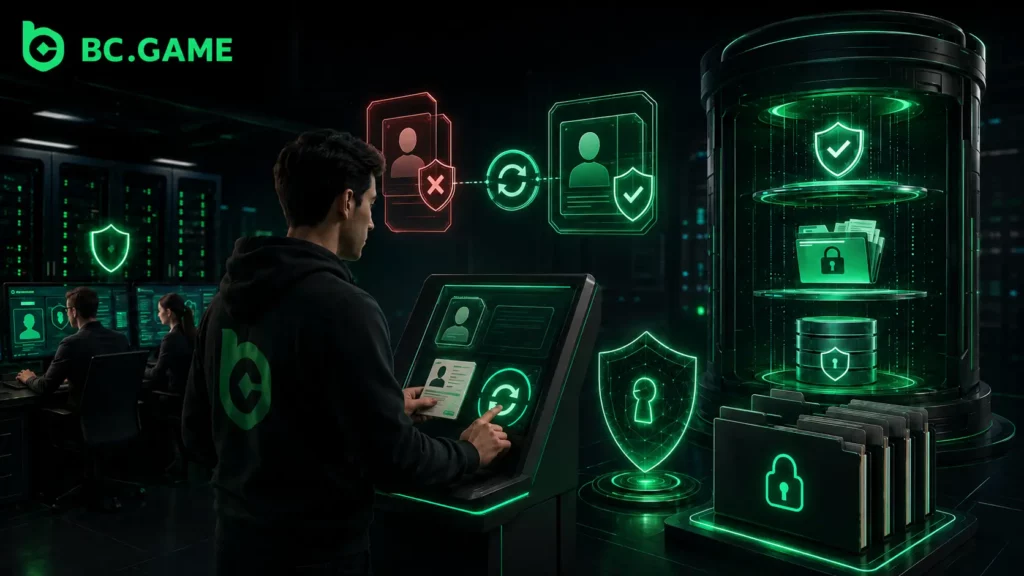
Verification records are processed for identity checks, fraud prevention, account administration and AML obligations. Approved verification and infrastructure providers may handle limited information for those defined purposes. Data may also be disclosed to competent authorities in response to a valid legal or regulatory request.
The data-retention model follows these principles:
- collect information for a specified compliance purpose;
- restrict access to authorized personnel and systems;
- retain records for applicable legal or contractual periods;
- supervise processing performed by approved providers;
- permit resubmission after rejection or document expiry;
- delete records securely when continued storage is not required.
A rejected file should be replaced after the user reads the stated reason. Repeatedly submitting the same expired, cropped or mismatched image will not correct the underlying problem.